



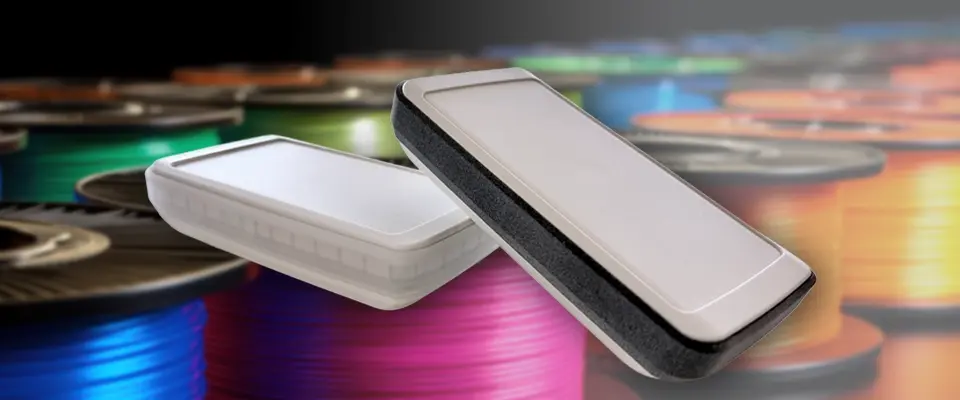
Which option offers the best solution: a housing produced using 3D printing, or one that is available from stock, even in quantities as low as a single unit? There is no one-size-fits-all answer, as the optimal choice depends on the specific application. In most cases, however, the following considerations apply.
For finished electronic devices that are intended for small to medium production runs, a standard enclosure is generally the more suitable choice. For prototypes and bespoke one-off projects, however, a 3D-printed enclosure offers distinct advantages.
When does it make sense to have a housing 3D-printed?
3D printing a housing is recommended if:
-
The project is still in the development phase
-
several design variants are to be tested
-
the housing requires a very specific shape
-
only a few units are required
-
rapid prototyping is more important than mass production.
When is a standard enclosure or stock enclosure the right choice?
A standard enclosure is usually the more cost-effective and technically superior solution if:
-
The product is to be sold in series production
-
a high protection rating (e.g. IP65 or IP67) and corresponding material properties are required
-
EMC requirements must be met
-
high mechanical strength is required
-
larger quantities are produced on a regular basis
Standard enclosures are available in numerous sizes and can be customised through drilling, milling, printing or membrane keypads. This often results in a virtually bespoke solution without having to develop a completely new enclosure, with the associated time and development costs.
Cost considerations
3D printing may initially appear cost-effective, but as production volumes increase, it can quickly become more expensive than a standard enclosure. Furthermore, factors such as post-processing, seals and reproducibility must be taken into account.
Whilst a standard enclosure incurs customisation costs, it offers the following in return:
- High-quality and tested materials
- defined and tested protection ratings
- existing approvals and certifications
- high-quality surface finishes and properties
- lower overall costs for series production
- precise fit with existing electronic components
Conclusion
If you wish to develop a functional product for series production, a standard enclosure with customised machining is, in most cases, the most suitable option. It is more robust, more professional, and, in the long run, more cost-effective.
A 3D-printed enclosure is the ideal choice for prototypes, feasibility studies or small-batch production, where flexibility and short development times are paramount.
Leave Your Feedback